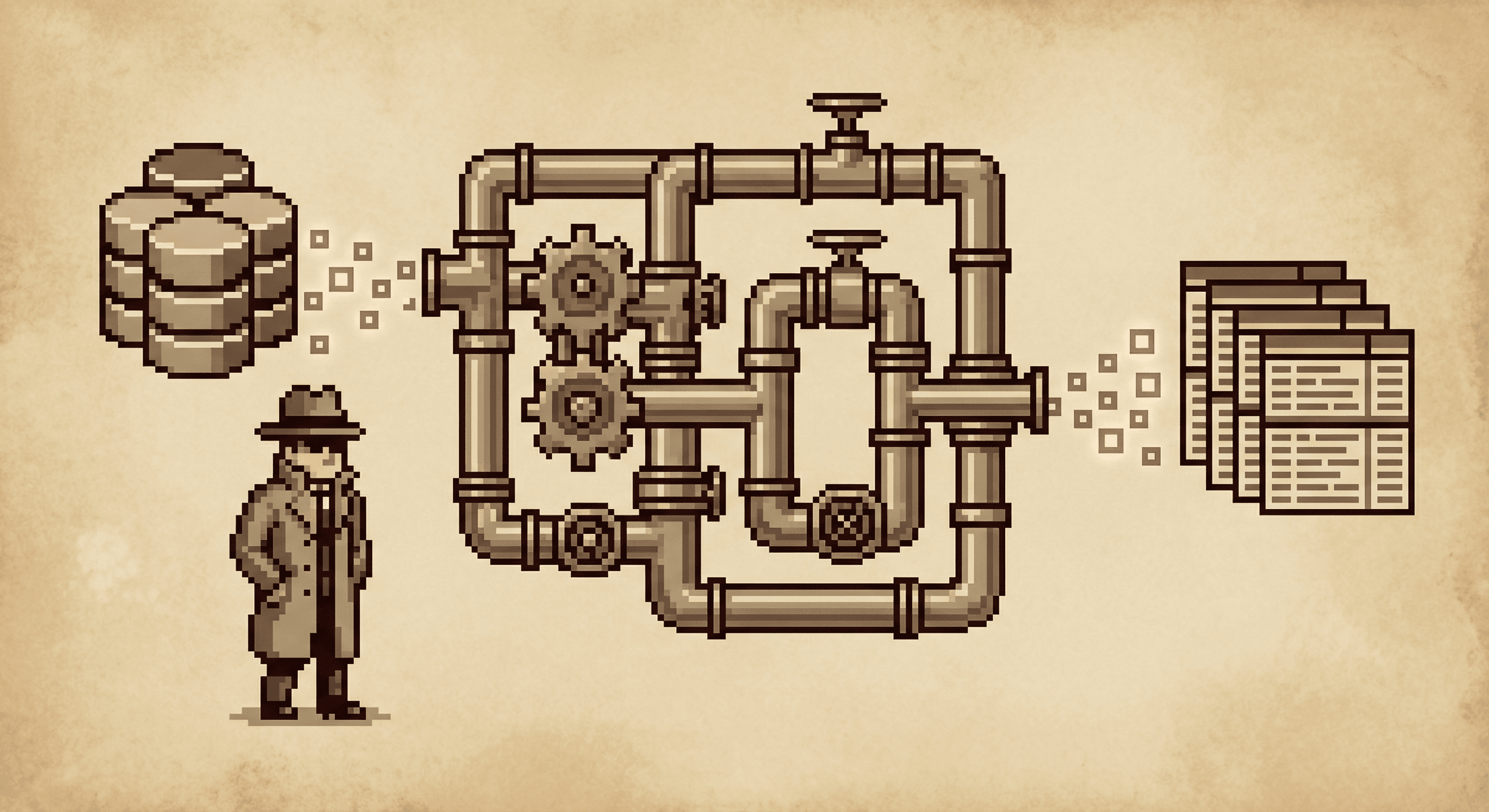
SQL for Data Engineers: The Complete Guide to Building Data Pipelines (2026)
Master the 7 SQL skills every data engineer needs. From CTEs and window functions to SCD patterns, pipeline optimization, and interview prep.
Data engineers write more SQL than anyone else in the building. If you want to build pipelines that don't break at 3 AM, here's what you actually need to know.
Quick Navigation
What Makes Data Engineering SQL Different
A data analyst writes a query, checks the results, and moves on. A data engineer writes a query that runs every night at 2 AM with no one watching. If it fails, dashboards go dark and stakeholders start asking questions before your coffee is ready.
That difference shapes everything about how data engineers approach SQL. Your queries need to be idempotent (safe to run multiple times), handle partial failures gracefully, and perform well at millions of rows. This is production code, not exploratory analysis.
| Focus Area | Data Engineer | Data Analyst |
|---|---|---|
| Primary Goal | Pipeline reliability | Business insights |
| SQL Runs... | Unattended at 2 AM | Ad-hoc during work hours |
| Scale | Millions of rows daily | Thousands for reports |
| Error Handling | Must handle failures gracefully | Can re-run manually |
| Key Patterns | MERGE, SCD, incremental loads | GROUP BY, window functions |
| Code Lifecycle | Production deployable | Exploratory, disposable |
Data Engineer vs Data Analyst: Different SQL, Different Goals
How Data Pipelines Use SQL
SQL powers every stage of a data pipeline. Whether you are building an ETL or ELT workflow, the same core patterns show up at each step.
Pull raw data from source systems
Quality checks before transformation
Clean, deduplicate, enrich with CTEs
MERGE into warehouse tables
Post-load quality checks and alerts
SQL Powers Every Stage of the Data Pipeline
The 7 skills below map directly to these pipeline stages. CTEs and window functions handle the Transform step. MERGE handles Load. Quality checks cover Validate and Monitor. Performance optimization keeps the entire pipeline running on schedule.
The 7 SQL Skills Every Data Engineer Needs
1. CTEs (Common Table Expressions)
CTEs are the foundation of readable, maintainable pipeline SQL. They let you break complex transformations into logical steps, making debugging infinitely easier when something breaks at 3 AM.
Example: Multi-Stage Pipeline
WITH raw_cases AS (
  SELECT
    case_id,
    detective_id,
    reported_date,
    case_status,
    priority_level
  FROM staging.incoming_cases
  WHERE reported_date >= CURRENT_DATE - INTERVAL '7 days'
),

validated_cases AS (
  SELECT *
  FROM raw_cases
  WHERE case_id IS NOT NULL
    AND detective_id IS NOT NULL
    AND case_status IN ('open', 'investigating', 'closed')
),

enriched_cases AS (
  SELECT
    c.*,
    d.detective_name,
    d.department,
    COUNT(e.evidence_id) AS evidence_count
  FROM validated_cases c
  LEFT JOIN dim_detectives d ON c.detective_id = d.detective_id
  LEFT JOIN fact_evidence e ON c.case_id = e.case_id
  GROUP BY c.case_id, c.detective_id, c.reported_date,
           c.case_status, c.priority_level,
           d.detective_name, d.department
)

SELECT * FROM enriched_cases;
Each CTE represents one transformation step: extract, validate, enrich. When the pipeline fails, query each CTE individually to find where the problem occurred.
The same CTE patterns you use in production pipelines work in SQLNoir's detective cases where you chain multi-stage queries to solve mysteries by transforming raw evidence tables into actionable insights.
2. Window Functions
Window functions let you perform calculations across rows without collapsing your result set. Critical for ranking, running totals, and detecting changes over time. If JOINs combine tables horizontally, window functions let you look at rows vertically.
Example: Tracking Case Status Changes
SELECT
  case_id,
  status_timestamp,
  case_status,
  LAG(case_status) OVER (
    PARTITION BY case_id ORDER BY status_timestamp
  ) AS previous_status,
  LEAD(case_status) OVER (
    PARTITION BY case_id ORDER BY status_timestamp
  ) AS next_status,
  ROW_NUMBER() OVER (
    PARTITION BY case_id ORDER BY status_timestamp DESC
  ) AS recency_rank
FROM case_status_history
WHERE case_id IN (SELECT case_id FROM active_investigations);
LAG and LEAD access previous and next rows. ROW_NUMBER identifies the most recent record. All without GROUP BY.
3. Data Deduplication
Duplicates are inevitable. Source systems send duplicate events, APIs return duplicates, and network retries create more. You need bulletproof deduplication logic.
Example: Removing Duplicate Evidence Records
WITH ranked_evidence AS (
  SELECT
    *,
    ROW_NUMBER() OVER (
      PARTITION BY evidence_id
      ORDER BY collected_timestamp DESC,
               ingestion_timestamp DESC
    ) AS row_num
  FROM staging.evidence_raw
)

INSERT INTO warehouse.fact_evidence
SELECT
  evidence_id,
  case_id,
  evidence_type,
  collected_timestamp,
  chain_of_custody
FROM ranked_evidence
WHERE row_num = 1;
ROW_NUMBER() with PARTITION BY identifies duplicates. We keep the most recently collected record. This pattern works for any deduplication scenario.
💡 Pro Tip
Always define a deterministic tiebreaker in your ORDER BY clause. If two records are truly identical, include a unique column like an ingestion timestamp to ensure consistent results across runs.
4. Incremental Loading
Full table scans are expensive and slow. Incremental loading processes only new or changed records, dramatically improving pipeline performance and reducing costs.
Example: Incremental Suspect Updates
MERGE INTO warehouse.dim_suspects target
USING (
  SELECT
    suspect_id,
    suspect_name,
    known_aliases,
    last_seen_location,
    updated_at
  FROM staging.suspects_incremental
  WHERE updated_at > (
    SELECT MAX(last_updated) FROM warehouse.dim_suspects
  )
) source
ON target.suspect_id = source.suspect_id
WHEN MATCHED THEN
  UPDATE SET
    suspect_name = source.suspect_name,
    known_aliases = source.known_aliases,
    last_seen_location = source.last_seen_location,
    last_updated = source.updated_at
WHEN NOT MATCHED THEN
  INSERT (suspect_id, suspect_name, known_aliases,
          last_seen_location, last_updated)
  VALUES (source.suspect_id, source.suspect_name,
          source.known_aliases, source.last_seen_location,
          source.updated_at);
MERGE handles both inserts and updates in one statement. The WHERE clause filters to only recent changes, processing a fraction of total rows.
5. Data Quality Checks
Data quality checks should be embedded directly in your pipeline SQL. Catch bad data before it pollutes your warehouse.
Example: Quality Validation Before Loading
WITH quality_checks AS (
  SELECT
    'null_case_ids' AS check_name,
    COUNT(*) AS failure_count
  FROM staging.new_cases
  WHERE case_id IS NULL

  UNION ALL

  SELECT
    'future_dates' AS check_name,
    COUNT(*) AS failure_count
  FROM staging.new_cases
  WHERE reported_date > CURRENT_DATE

  UNION ALL

  SELECT
    'invalid_status' AS check_name,
    COUNT(*) AS failure_count
  FROM staging.new_cases
  WHERE case_status NOT IN (
    'open', 'investigating', 'closed', 'cold'
  )
)

SELECT * FROM quality_checks WHERE failure_count > 0;
Run this before your main pipeline. If any check returns rows, halt the pipeline and alert. Prevention beats cleanup every time.
6. Slowly Changing Dimensions (SCD)
Tracking historical changes is essential for accurate reporting. Type 2 SCD is the industry standard for maintaining full history in dimension tables.
Example: Type 2 SCD Implementation
-- Step 1: Expire changed records
UPDATE warehouse.dim_detectives
SET
  valid_to = CURRENT_DATE - INTERVAL '1 day',
  is_current = FALSE
WHERE detective_id IN (
  SELECT detective_id
  FROM staging.detective_updates
)
AND is_current = TRUE;

-- Step 2: Insert new versions
INSERT INTO warehouse.dim_detectives (
  detective_id, detective_name, department,
  rank, valid_from, valid_to, is_current
)
SELECT
  detective_id,
  detective_name,
  department,
  rank,
  CURRENT_DATE AS valid_from,
  '2099-12-31'::DATE AS valid_to,
  TRUE AS is_current
FROM staging.detective_updates;
Type 2 SCD maintains full history. Each change creates a new row with valid_from and valid_to dates. The is_current flag simplifies queries for the latest state.
7. Performance Optimization
Understanding query execution plans is non-negotiable for data engineers. Your pipelines process millions of rows. A poorly optimized query can run for hours instead of minutes.
Example: Analyzing Query Performance
-- Check execution plan before running
EXPLAIN ANALYZE
SELECT
  c.case_id,
  c.case_status,
  COUNT(e.evidence_id) AS evidence_count
FROM cases c
LEFT JOIN evidence e ON c.case_id = e.case_id
WHERE c.reported_date >= '2024-01-01'
GROUP BY c.case_id, c.case_status;

-- Add index to improve join performance
CREATE INDEX idx_evidence_case_id
  ON evidence(case_id);

-- Partition large tables by date
CREATE TABLE cases_partitioned (
  case_id BIGINT,
  reported_date DATE,
  case_status VARCHAR(50)
) PARTITION BY RANGE (reported_date);
EXPLAIN ANALYZE shows where your query spends time. Add indexes on JOIN and WHERE columns. Partition tables by date for faster scans.
Practice These Patterns on Real Databases
The SQL skills you just learned (CTEs, window functions, complex JOINs, aggregations) transfer directly to SQLNoir's detective cases. Query real databases with tables like crime_scene, suspects, and interviews to build the muscle memory you need for pipeline work.
ETL vs ELT: Where SQL Fits
The biggest shift in data engineering over the past decade is the move from ETL (Extract, Transform, Load) to ELT (Extract, Load, Transform). The difference matters because it changes SQL's role entirely.
| Aspect | ETL | ELT |
|---|---|---|
| Transform Timing | Before loading | After loading |
| Where SQL Runs | Staging server | Inside the warehouse |
| Scale | Limited by staging server | Warehouse-scale (elastic) |
| Tools | SSIS, Informatica, Talend | dbt, Snowflake, BigQuery |
| Best For | Legacy systems, on-prem | Cloud data platforms |
| SQL Role | Part of the process | The entire transformation layer |
ETL vs ELT: How SQL's Role Differs
In the ELT world, SQL is not just one tool in the chain. It is the transformation layer. Tools like dbt codified this pattern: you write SQL models that define how raw data becomes clean, analytics-ready tables.
Example: dbt-Style SQL Model
-- models/mart_case_summary.sql
-- This runs inside your warehouse as an ELT transformation

WITH closed_cases AS (
  SELECT
    case_id,
    detective_id,
    reported_date,
    closed_date,
    closed_date - reported_date AS days_to_close
  FROM {{ ref('stg_cases') }}
  WHERE case_status = 'closed'
),

detective_stats AS (
  SELECT
    detective_id,
    COUNT(*) AS cases_closed,
    AVG(days_to_close) AS avg_days_to_close,
    MIN(days_to_close) AS fastest_close
  FROM closed_cases
  GROUP BY detective_id
)

SELECT
  d.detective_name,
  d.department,
  s.cases_closed,
  s.avg_days_to_close,
  s.fastest_close
FROM detective_stats s
JOIN {{ ref('dim_detectives') }} d
  ON s.detective_id = d.detective_id;
In ELT, this SQL runs inside the warehouse. dbt manages dependencies between models, runs tests, and generates documentation automatically.
SQL in the Modern Data Stack
Regardless of which tools you use, SQL skills for data engineering remain essential. The syntax varies slightly between platforms, but the core concepts transfer everywhere.
| Tool | Type | SQL Dialect | Key Feature |
|---|---|---|---|
| dbt | Transform | Jinja + SQL | Version-controlled SQL models |
| Snowflake | Warehouse | ANSI SQL | Auto-scaling, time travel |
| BigQuery | Warehouse | Standard SQL | Serverless, ML functions |
| Redshift | Warehouse | PostgreSQL | Distribution and sort keys |
| Spark SQL | Processing | HiveQL / ANSI | Distributed processing |
| Airflow | Orchestration | SQL operators | DAG-based scheduling |
SQL in the Modern Data Stack
Master CTEs, window functions, and performance optimization, and you can work with any modern data warehouse. The patterns from this guide apply whether you are writing raw SQL, dbt models, or Spark SQL jobs.
SQL Interview Questions for Data Engineers
Interview questions for data engineering roles focus on practical pipeline problems, not brain teasers. Here are real scenarios you will encounter.
Question 1: Deduplicate a Table
Problem:
A table has duplicate rows based on user_id. Keep only the most recent record for each user.
WITH latest_events AS (
  SELECT
    *,
    ROW_NUMBER() OVER (
      PARTITION BY user_id
      ORDER BY event_timestamp DESC
    ) AS rn
  FROM user_events
)
DELETE FROM user_events
WHERE (user_id, event_timestamp) NOT IN (
  SELECT user_id, event_timestamp
  FROM latest_events
  WHERE rn = 1
);
Question 2: Find Gaps in Sequential Data
Problem:
Find missing case_ids in a sequence (e.g., 1, 2, 4, 5, 8 has gaps at 3, 6, 7).
WITH case_sequence AS (
  SELECT
    case_id,
    LEAD(case_id) OVER (ORDER BY case_id) AS next_case_id
  FROM cases
)
SELECT
  case_id + 1 AS gap_start,
  next_case_id - 1 AS gap_end
FROM case_sequence
WHERE next_case_id - case_id > 1;
Question 3: Running Totals and Moving Averages
SELECT
  case_date,
  cases_opened,
  SUM(cases_opened) OVER (
    ORDER BY case_date
  ) AS cumulative_cases,
  AVG(cases_opened) OVER (
    ORDER BY case_date
    ROWS BETWEEN 6 PRECEDING AND CURRENT ROW
  ) AS seven_day_avg
FROM daily_case_stats
ORDER BY case_date;
Question 4: Write an Idempotent MERGE
Problem:
Write a MERGE that can run multiple times safely without creating duplicates.
MERGE INTO warehouse.suspects target
USING staging.suspect_updates source
ON target.suspect_id = source.suspect_id
  AND target.is_current = TRUE
WHEN MATCHED
  AND source.updated_at > target.last_updated THEN
  UPDATE SET
    suspect_name = source.suspect_name,
    last_updated = source.updated_at
WHEN NOT MATCHED THEN
  INSERT (suspect_id, suspect_name,
          last_updated, is_current)
  VALUES (source.suspect_id, source.suspect_name,
          source.updated_at, TRUE);
The additional condition checking updated_at prevents re-processing old data if the pipeline runs twice.
Question 5: Implement Type 2 SCD
Problem:
A detective changes departments. Update the dimension table while preserving history.
-- Expire the old record
UPDATE dim_detectives
SET valid_to = CURRENT_DATE, is_current = FALSE
WHERE detective_id = 1042 AND is_current = TRUE;

-- Insert the new version
INSERT INTO dim_detectives (
  detective_id, detective_name, department,
  valid_from, valid_to, is_current
)
VALUES (
  1042, 'Sarah Chen', 'Homicide',
  CURRENT_DATE, '2099-12-31', TRUE
);
How to Learn SQL for Data Engineering (8-Week Roadmap)
Learning SQL for data engineering requires deliberate practice on production patterns, not just syntax. Here is a focused 8-week plan. If you are wondering whether SQL is hard to learn, the basics come quickly. The pipeline patterns in weeks 5 through 8 are where real expertise develops.
SQL Foundations
Weeks 1-2SELECT, WHERE, JOINs, GROUP BY, HAVING, subqueries, basic CTEs, CASE statements, NULL handling
Advanced Patterns
Weeks 3-4Window functions (ROW_NUMBER, RANK, LAG, LEAD), self-joins, UNION/INTERSECT/EXCEPT, date manipulation
Pipeline SQL
Weeks 5-6MERGE/UPSERT, incremental loading, data quality validation, SCD Type 2, idempotent query design
Optimization and Practice
Weeks 7-8EXPLAIN plans, indexing strategy, partitioning, interview prep, build an end-to-end pipeline project
8-Week SQL Learning Roadmap for Data Engineers
💡 Pro Tip
Spend 80% of your time on weeks 5 through 8. Foundations are important, but pipeline patterns are what actually get you hired. Practice on realistic datasets with millions of rows to understand performance at scale. For interactive practice, SQL learning games can help build query muscle memory.
Ready to Put Pipeline SQL into Practice?
You have learned the theory: CTEs, window functions, MERGE, SCD patterns, and quality checks. Now drill those same SQL patterns by solving detective cases. Query multi-table databases to build the muscle memory that transfers to any data engineering work.
Start Your Investigation →Common Pipeline Mistakes to Avoid
1. Using SELECT * in Production
SELECT * makes your pipeline fragile. When someone adds a column to the source table, your pipeline breaks or pulls sensitive data you didn't intend to process.
Fix: Always specify exact columns.
2. Not Handling NULLs Properly
NULL != NULL in SQL. Comparisons with NULL require IS NULL or IS NOT NULL, not = or !=. Missing this breaks JOIN conditions and WHERE filters silently.
Fix: Use COALESCE() for defaults and IS NULL for comparisons.
3. Missing Indexes on Large Tables
Joining or filtering large tables without indexes forces full table scans. A query that should take seconds runs for hours.
Fix: Create indexes on JOIN keys and frequently filtered columns.
4. Writing Non-Idempotent Queries
If your pipeline runs twice (network retry, manual rerun, scheduler glitch), will it create duplicate data? Non-idempotent SQL is a production disaster waiting to happen.
Fix: Use MERGE instead of INSERT. Add timestamp checks. Design for reruns.
5. Ignoring EXPLAIN Plans
Running queries blind without checking execution plans means you have no idea if your query is doing full table scans, inefficient joins, or missing obvious optimizations.
Fix: Always run EXPLAIN before deploying expensive queries to production.
Frequently Asked Questions
Is SQL enough for data engineering?
SQL is essential but not sufficient on its own. Data engineers also need Python (or Scala), orchestration tools like Airflow or Prefect, cloud platforms (AWS, GCP, Azure), and infrastructure skills (Docker, Kubernetes). That said, SQL is the foundation. You will write more SQL than any other language in a typical data engineering role.
Do data engineers need to know Python and SQL?
Yes. SQL handles data transformations inside the warehouse. Python handles orchestration, API calls, custom business logic, and anything SQL cannot express. Modern data engineers are fluent in both. Start with SQL, then add Python as you hit problems SQL cannot solve.
Is SQL still relevant for data engineering in 2026?
Absolutely. SQL has been the standard for 50 years and is not going anywhere. Every modern data warehouse (Snowflake, BigQuery, Redshift, Databricks) uses SQL as its primary interface. Tools like dbt are doubling down on SQL. The syntax evolves, but the core concepts remain fundamental.
What is the best way to practice SQL for data engineering?
Practice on realistic, large datasets using production patterns. Build an end-to-end pipeline: load data incrementally, deduplicate, track history with SCD, add quality checks, and optimize performance. Focus on pipeline scenarios rather than syntax puzzles.
Will AI replace SQL for data engineers?
AI can generate SQL queries, but it cannot design pipeline architectures, ensure idempotency across complex workflows, or handle the edge cases that break production systems. Think of it like calculators and math: calculators did not replace the need to understand mathematics. AI is a productivity tool, not a replacement for understanding how data pipelines work.
Ready to start your next investigation?
Jump into the SQLNoir case files and put these tips to work.